


A Short Border With a Long List of Variables
Saudi Arabia and the UAE share a land border, a common currency bloc, and decades of integrated trade. You’d think moving a pallet of HP toner from Jebel Ali to Riyadh would be about as complicated as a domestic delivery. In practice, it’s more nuanced than that—and purchase managers who’ve learned the hard way will tell you the complications are almost never the ones you’d predict going in.
Part numbers get confirmed over the phone and then shipped wrong. VAT documentation gets missed and holds up clearance at Al Batha or the King Khalid International freight terminal. A supplier who quoted competitively turns out to be moving grey-market stock, and the cartridges start throwing authentication errors on the fifth day of use. None of these problems are unsolvable. But they’re all avoidable, and the difference between the procurement managers who avoid them and those who keep repeating them usually comes down to process, not luck.
This guide is written for purchase managers handling bulk HP toner procurement in Saudi Arabia—whether you’re sourcing for a single large corporate account, managing supply for a network of resellers across Riyadh, Jeddah, and Dammam, or running a government procurement desk that needs documented authenticity on every unit. The Dubai-to-Saudi supply route is genuinely one of the most efficient in the region for printer consumables. Getting the most out of it just requires understanding where the friction points actually sit.
GTI (Genuine Toner Ink) has been working this route for long enough to know where the problems cluster—and this article draws on that experience to give Saudi procurement teams a practical map of what to expect, what to verify, and what to build into their standard operating process.
Why Dubai Remains the Primary Source for HP Toner in the GCC
The UAE’s dominance as a regional distribution hub for printer consumables isn’t purely about geography, though Jebel Ali’s position and port infrastructure certainly help. It’s about the combination of factors that makes Dubai uniquely suited to high-volume wholesale trade: the free zone system, the depth of inventory, the number of authorized distributors operating in the market, and the logistics ecosystem that’s built up around all of it.
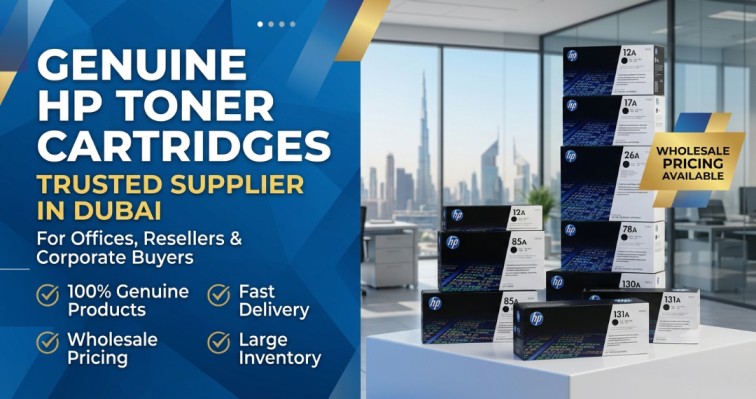
For HP toner specifically, Dubai hosts some of the largest authorized wholesale operations in the Middle East. HP’s regional distribution network routes significant volume through UAE-based distributors, which means buyers sourcing genuine stock are closer to the top of the supply chain than they would be purchasing through Riyadh-based intermediaries who are themselves importing from Dubai. That extra link in the chain adds margin. It sometimes adds risk. Working directly with HP toner suppliers in Dubai for Saudi Arabia removes both.
The free zone advantage is worth spelling out. Companies operating out of JAFZA, DAFZA, and other Dubai trade zones benefit from streamlined re-export procedures, minimal corporate tax exposure, and established relationships with freight forwarders who move goods into the Kingdom regularly. That infrastructure maturity translates into faster documentation turnaround, fewer surprises at the Saudi customs clearance stage, and pricing that reflects genuine wholesale economics rather than a series of compounding margins.
Inventory depth is the other factor that keeps Saudi procurement managers coming back to Dubai rather than exploring alternative sources. A well-stocked Dubai toner wholesaler will carry current-generation HP LaserJet and Color LaserJet stock alongside older models that remain in active use across Saudi government offices, educational institutions, and healthcare facilities. Finding niche part numbers for end-of-life printer models — the kind of stock that’s dried up in local Saudi supply chains — is often a same-day conversation with the right Dubai supplier.
The Cross-Border Logistics Route: What Actually Happens to Your Order
The physical journey from a Dubai warehouse to a Saudi delivery address is well-travelled and genuinely efficient when it’s managed properly. Most bulk HP toner shipments move one of two ways: overland by truck through the Al Batha border crossing on the Abu Dhabi-Saudi border, or by air freight through King Khalid International or King Abdulaziz International for urgent or time-sensitive orders.
Overland is the standard for bulk. A loaded truck from Jebel Ali to Riyadh typically runs 12 to 18 hours of driving time, with border processing at Al Batha adding anywhere from a few hours to a full day depending on documentation completeness and border volumes. Well-prepared shipments with clean paperwork move through in three to five hours. Shipments with documentation gaps — wrong HS code, missing certificate of origin, VAT registration numbers not matching — sit. And while they sit, the delivery window closes and the calls start.
The documentation checklist for Saudi customs isn’t unusually complex, but it requires attention. Commercial invoice, packing list, certificate of origin (UAE-issued for GCC preferential tariff treatment), SASO compliance documentation where applicable, and accurate HS code classification for printer consumables. Since the introduction of VAT in Saudi Arabia, the importer’s VAT registration number needs to appear correctly on the invoice — a small thing that causes disproportionate delays when it’s missing or mistyped.
Air freight runs King Khalid cargo terminal for Riyadh, King Abdulaziz for Jeddah, and King Fahd International for Dammam and the Eastern Province. Transit times from Dubai are effectively same-day to next-day for air, with customs clearance adding 24 to 48 hours in normal conditions. The cost premium over road freight is significant — typically two to three times the overland rate per kilogram — which makes air viable for urgent top-ups and initial sample orders, not for routine bulk procurement. HP toner suppliers in Dubai for Saudi Arabia who handle regular shipments will have established accounts with freight forwarders running both routes and can advise on cost-transit tradeoffs for specific order sizes.
Understanding Saudi VAT, Customs Duties and What They Do to Your Cost Model
Saudi Arabia applies a 15% VAT rate on imported goods, which has been at that level since the 2020 increase from the original 5%. For a procurement manager building a cost model for bulk HP toner imports, this needs to be in the spreadsheet from the first line — not added as an afterthought once the supplier quote is agreed. The number that looks attractive as a Dubai FOB price looks different after VAT, duty, freight, and clearing fees are stacked on top.
Import duty on printer consumables under the GCC Common External Tariff is generally 5% for goods classified under HS code 8443.99, though the exact rate depends on precise product classification and whether the goods qualify for intra-GCC preferential treatment. UAE-origin goods moving to Saudi Arabia under the GCC preferential tariff agreement can qualify for reduced or zero duty — but this requires proper certificate of origin documentation issued by the UAE Chambers of Commerce, not just a supplier’s assertion that the goods are UAE-origin. Missing that certificate means paying the full external tariff rate, which eats into your landed cost calculation significantly.
Clearing agent fees, port handling, inland transport within Saudi Arabia, and last-mile delivery to your warehouse all add to the picture. A realistic landed cost estimate for bulk HP toner moving from Dubai to Riyadh, inclusive of all duties, VAT, freight, and clearing costs, typically runs 25 to 40 percent above the Dubai FOB price depending on shipment size and routing. The larger the shipment, the better the per-unit freight economics, but the VAT and duty calculation scales linearly with order value. Build the model before you agree the price, not after the goods are in transit.
One practical note: Saudi customs has become significantly more efficient over the past few years, particularly for import-registered businesses with clean compliance histories. Companies that import HP toner regularly and have their VAT registration, HS code classification, and supplier documentation consistently in order find clearance times have shortened considerably. The friction is mostly concentrated on first shipments and on shipments where the documentation doesn’t match what the system expects. Experienced HP toner suppliers in Dubai for Saudi Arabia will know what Saudi customs expects and document accordingly from the start.
Verifying Product Authenticity: The Saudi Market Has a Counterfeiting Problem
It would be convenient to assume that buying from a Dubai-based supplier, rather than from a local Saudi intermediary, automatically means you’re buying genuine HP product. It doesn’t. The counterfeiting operation for HP toner is sophisticated enough to have penetrated multiple distribution levels across the GCC, and Saudi Arabia’s size and the volume it consumes makes it a significant target market for fake consumables.
The tell-tale signs aren’t always obvious. Counterfeit cartridges have improved dramatically in external appearance — the packaging, the holographic labels, even the chip responses have gotten closer to genuine. What tends to give them away is performance: inconsistent yield, fading or streaking after a few hundred pages, and eventually printer errors that look like mechanical faults but trace back to cartridge chemistry. By the time a corporate client or government department starts logging complaints, the order is long-since paid for and the supplier relationship is on the line.
The verification process doesn’t have to be complicated. HP’s Authentication app allows chip scanning at the point of receipt — any genuine HP cartridge will authenticate immediately. The holographic label has security features visible under close inspection. And any legitimate supplier should be able to provide documentation tracing the stock back to an HP-authorised source — a distribution agreement, an authorisation letter, or purchase records from a recognised HP regional distributor.
GTI’s supply chain is built around sourcing from HP-authorised channels, which means the documentation exists and we’re comfortable sharing it. That’s not an unusual standard to set. When you’re evaluating HP toner suppliers in Dubai for Saudi Arabia, make it a baseline requirement. Ask for the authorisation documentation before you place the order, not after a problem surfaces. A supplier who can’t produce it, or who is vague about where their stock originates, is telling you something important about the risk you’d be taking on.
Part Numbers, Regional Variants and the Errors That Surface Three Weeks After Delivery
Saudi Arabia sits in HP’s Middle East and Africa distribution region, which matters when it comes to cartridge chip configuration. HP produces toner cartridges in regional variants that are chip-encoded for specific geographic markets — and while a UAE-region cartridge and a MEA-region cartridge may be physically identical and print perfectly well on most devices, some printer firmware versions will flag a regional mismatch and either restrict use or log a non-genuine cartridge warning.
This is not a theoretical risk. It shows up regularly in bulk orders where the buyer has assumed regional compatibility without confirming it, or where a supplier has sourced stock from a mixed-origin lot without flagging the variant differences. The printer error message looks like a bad cartridge. The client assumes it’s a counterfeit. You spend two days proving it isn’t while the relationship takes a hit it didn’t need to take.
The fix is straightforward: confirm regional specification in writing before the order is placed. Any competent HP toner supplier will know which variant they’re selling and be able to document it. For Saudi procurement specifically, you want MEA-region stock as the default, or UAE-region stock where your supplier can confirm the relevant printer models in your client base are compatible. Don’t accept ‘it’ll work fine’ as an answer. Get the variant confirmed in the purchase order.
The standard-yield versus high-yield distinction also deserves attention at the bulk order stage. CF217A and CF217X, for example — both fit the HP LaserJet Pro M102 and M130 series. One yields around 1,600 pages; the other 4,000. The price difference looks small per unit in a catalog. Across a bulk order it’s significant, and if your client is expecting high-yield and receives standard-yield, the conversation is uncomfortable regardless of whose fault the confusion was. Cross-reference every part number against HP’s official compatibility database before confirming quantities. It takes ten minutes and saves considerably more.
Choosing the Right Dubai Supplier for Saudi Volume
Saudi Arabia’s demand profile is different from other GCC markets in ways that matter when selecting a Dubai wholesale partner. Corporate procurement cycles tend to run on longer lead times with higher volume commitments. Government tenders require specific documentation — authenticity certificates, compliance letters, sometimes third-party inspection reports. Healthcare and education sector buyers often have VAT exemption documentation requirements that need to be handled correctly from the invoice stage. A supplier who handles consumer retail volumes efficiently may not have the operational infrastructure to support institutional Saudi procurement.
When you’re assessing HP toner suppliers in Dubai for Saudi Arabia, the questions worth asking are specific. How many shipments do they currently move to Saudi Arabia monthly? Which freight forwarders do they use for the overland and air routes? Can they produce SASO compliance documentation where required? Do they issue invoices in SAR or USD, and can they accommodate VAT-registered billing correctly? Have they handled tender supply for Saudi government entities before?
Export experience on the Saudi route specifically is more valuable than general wholesale scale. A large Dubai toner distributor who primarily serves UAE domestic demand and has limited experience with Saudi customs requirements will generate the same documentation headaches as a smaller supplier who hasn’t done the route before. What you want is a supplier who does Saudi shipments regularly enough to know what King Abdulaziz Customs Authority expects on an invoice, what SASO documentation looks like, and how to handle the occasional query from Saudi customs without the shipment stalling.
Minimum order flexibility matters too, particularly for procurement teams testing a new supplier relationship. Starting with a smaller order — enough to verify the product quality, the logistics reliability, and the documentation accuracy — before committing to full quarterly volume is a sensible approach regardless of how confident the supplier appears on paper. GTI’s commercial structure accommodates that kind of staged onboarding, and any serious wholesale partner should be willing to do the same.
Common Mistakes Saudi Purchase Managers Make on the Dubai Route
Treating the Dubai-to-Saudi route as simpler than it is because the distance is short is probably the most common starting point for problems. Three hundred kilometres of road doesn’t mean three hundred kilometres of straightforward logistics. The border crossing, the VAT documentation, the customs classification, and the supplier verification all require the same attention they’d get on a much longer international route — because the consequences of getting them wrong are identical.
Confirming part numbers verbally rather than in writing is the one that generates the most returns and the most frustrating conversations. A supplier’s sales rep saying ‘yes, that’s the CF258X’ over a phone call is not the same as a written purchase order specifying CF258X, MEA-region variant, high-yield, with a page yield confirmation. The written spec is what you go back to when the wrong product arrives. Without it, the conversation about who’s responsible goes in circles.
Underestimating clearance timelines for first shipments is another consistent issue. Buyers who’ve been told the road transit is 12 hours plan for a 24-hour door-to-door delivery. They haven’t factored in that Al Batha border processing on a first shipment, with customs wanting to inspect documentation for a new importer, can add a full day. Build buffer into your first few orders. Once the relationship with Saudi customs is established and your importer profile is clean in the system, clearance speeds up considerably.
Finally, not maintaining a supplier backup. The procurement managers who run into the most severe disruptions are those running their entire HP toner supply through a single Dubai source. Supplier stock-outs, shipping disruptions, payment disputes — any of these can create a supply gap at the worst possible moment. Having a verified secondary supplier, even one you use infrequently, provides the kind of resilience that a single-supplier arrangement simply can’t.
Building a Procurement Operation That Runs Without Constant Firefighting
The purchase managers who handle Dubai-to-Saudi HP toner procurement without constant complications have usually built the same things: a short list of verified, documented suppliers; a compatibility matrix that maps every printer model in their client base to the correct MEA-region part number; a clearing agent in Riyadh or their primary delivery city who knows their import profile; and a cost model that includes VAT, duty, and freight from line one.
None of that is complicated to build. It takes some initial work and a few carefully managed first shipments to get the details calibrated. After that, it mostly runs on its own.
HP toner suppliers in Dubai for Saudi Arabia who do this route well understand that their job isn’t just supplying product — it’s supporting the procurement process on the Saudi end, which means getting documentation right, flagging regional variant questions before they become problems, and being reachable when something at the border needs a quick answer. That’s the standard GTI holds itself to, and it’s the standard worth applying when evaluating any wholesale partner for this route.
The cost advantage of sourcing directly from Dubai rather than through Saudi intermediaries is real — typically 15 to 25 percent on landed cost for buyers doing meaningful volume. Getting that advantage consistently requires the groundwork to be in place. Put the process together once, properly, and the economics follow.